Simulation-Based Power Analysis
Definition
Simulation-based power analysis estimates the operating characteristics (type I error, power, sample size requirements) of a clinical trial design by repeatedly sampling replicate trial datasets from a specified data-generating model and analyzing each under the prospectively defined statistical method. Unlike closed-form analytical formulas, simulation accommodates complex, non-standard scenarios: non-proportional hazards (NPH), multiple testing with complicated multiplicity structures, adaptive designs, and conditional power assessments.
When Simulation Is Required vs Analytical Formulas
Analytical Formulas Are Sufficient When:
-
Single time-to-event endpoint, proportional hazards
- Closed-form: Required events d = (z_α + z_β)² / (log HR)² [Schoenfeld 1981]
- Log-rank test is optimal
- No interim analyses or simple group sequential design (O'Brien-Fleming, Pocock)
-
Straightforward covariate-adjusted continuous endpoint
- ANCOVA or MMRM with standard covariance structures
- Single test statistic; no multiplicity
-
Fixed sample size, single hypothesis
- No adaptive re-estimation, enrichment, or endpoint switching
Simulation Is Essential When:
-
Non-Proportional Hazards (NPH)
- Delayed treatment effect (immunotherapy: slow ramp-up, sustained benefit)
- Crossing hazard curves (safety concern initially, then benefit)
- Cure fractions (permanent separation of survival curves)
- Why: Log-rank test is suboptimal or severely underpowered; MaxCombo or RMST needed
-
Multiplicity and Complex Hypothesis Structure
- Multiple co-primary endpoints
- Hierarchical secondary endpoints with graphical methods
- Adaptive enrichment (select subpopulation at interim)
- Number of intersection hypotheses grows exponentially; even 2 co-primaries × 2 interims requires simulation to verify FWER control
-
Adaptive Designs
- Sample size re-estimation at interim
- Endpoint switching or addition
- Randomization ratio changes
- Closed-form inflation factors inadequate
-
Conditional Power and Re-planning
- IDMC needs interim predictive probability of trial success
- Re-estimation must preserve type I error under sequential testing rules
-
Custom statistical methods or test combinations
- MaxCombo (max of multiple weighted log-rank tests)
- RMST with adaptive time horizon
- Joint modeling of longitudinal + competing event (QoL + death)
NPH Scenarios: Clinical Patterns & Simulation Strategies
Scenario 1: Delayed IO Effect (Immunotherapy Ramp-Up)
Clinical pattern:
- Months 0–6: Minimal treatment effect (HR ≈ 1); immune system is priming
- Months 6–24: Sustained benefit (HR = 0.65 for immunotherapy vs chemotherapy)
- Rationale: PD-1/PD-L1 inhibitors require time for T-cell expansion
Hazard profile:
Month:      0---3---6---12---24---36
HR:         1.0......0.65........0.65
Survival curves:
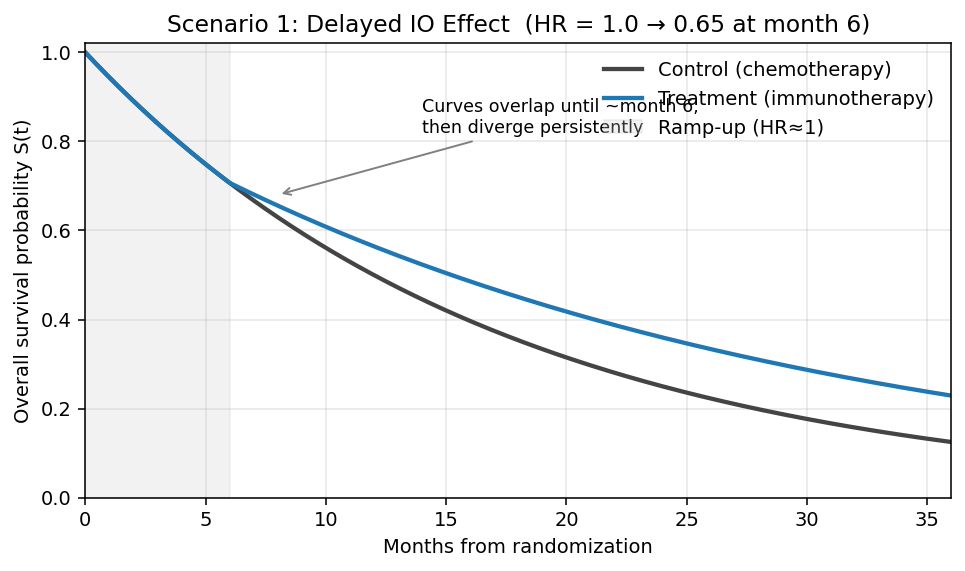
- Curves superimpose during months 0–6 (no visible separation)
- Treatment curve diverges above control after month 6; gap widens progressively
- Long-term tail: persistent plateau advantage for treatment
Impact on standard log-rank test:
- Log-rank test weights all events equally
- Early events contribute noise (null effect period)
- Power severely underestimated by proportional-hazards sample size formula
- Example: Analytical n=320 (PH assumption) → Actual power 45% vs claimed 80%
Simulation & remedy:
- Use Fleming-Harrington (1,1) or FH(1,0): weights late events more heavily
- Use MaxCombo: combines FH(0,0) + FH(1,0) + FH(0,1) + FH(1,1); robust across multiple NPH patterns
- Recommended primary: MaxCombo; sensitivity: log-rank
- Follow-up duration: Design for ≥24 months to capture delayed benefit
Simulation example (R, simtrial):
library(simtrial)
library(gsDesign2)

# Delayed IO effect: HR=1.0 months 0–6, HR=0.65 thereafter
delayed_io <- define_fail_rate(
  duration  = c(6, 999),          # Two periods: ramp (6 mo) then sustained
  fail_rate = c(0.0578, 0.0578),  # Control λ (median OS = 12 mo)
  hr        = c(1.00, 0.65),      # HR by period
  dropout_rate = 0.01
)

sim_delayed <- sim_fixed_n(
  n_sim       = 10000,
  sample_size = 400,
  block       = c(rep("control", 1), rep("experimental", 2)),  # 2:1
  stratum     = data.frame(stratum = "All", p = 1),
  enroll_rate = define_enroll_rate(duration = 18, rate = 22),
  fail_rate   = delayed_io,
  total_duration = 36,
  test        = list(maxcombo, logrank, rmst_milestone(tau = 24))
)

# Compare operating characteristics across tests
summary(sim_delayed)
# Expected: MaxCombo ≈ 82% power, log-rank ≈ 65%, RMST(24) ≈ 80%
Scenario 2: Crossing Hazard Curves (Early Harm, Late Benefit)
Clinical pattern:
- Months 0–3: HR = 1.5 (toxicity/resistance; treatment arm worse)
- Months 3–12: HR = 0.65 (late benefit emerges)
- Rare but catastrophic if missed: hormone therapy vs chemotherapy; checkpoint inhibitors in certain populations
Hazard profile:
Month:      0---3---12---24
HR:         1.5...0.65.....0.65
Survival curves:
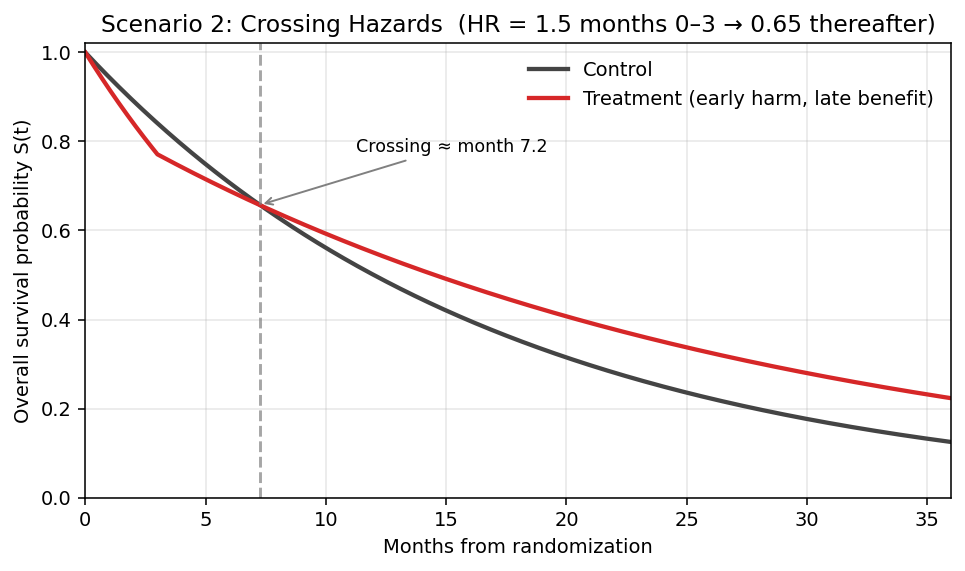
- Treatment curve starts below control (early toxicity or resistance)
- Curves cross at ~month 3, then treatment runs above control
- Net benefit only observable after crossover; short follow-up misses it
Impact:
- Log-rank test: CATASTROPHIC power loss
- If trial powered for late benefit (HR=0.65), early harm (HR=1.5) is ignored by log-rank
-
Net effect at interim may be null; trial may fail due to survival at early timepoint being worse in treatment arm
-
Kaplan-Meier curve crossing: Violates proportional hazards assumption; standard confidence intervals invalid
Regulatory consequence:
- FDA views crossing curves as potential safety signal; trial may be stopped for futility or safety
- IDMC must carefully monitor interim KM curves; pre-specify stopping rule for crossing
Simulation & remedy:
- Do NOT use log-rank alone; simulate under crossing scenario
- Optimal: MaxCombo (robust to crossing patterns)
- Alternative: RMST with fixed time horizon ≥ crossing point (e.g., 12 months)
- Design recommendation: Accept delayed proof of benefit; extend follow-up duration ≥ crossover time
Simulation example (R, simtrial):
library(simtrial)

# Crossing hazards: HR=1.5 months 0–3 (early harm), HR=0.65 months 3+ (late benefit)
crossing <- define_fail_rate(
  duration     = c(3, 999),
  fail_rate    = c(0.0578, 0.0578),
  hr           = c(1.50, 0.65),       # Early harm → late benefit
  dropout_rate = 0.01
)

sim_crossing <- sim_fixed_n(
  n_sim          = 10000,
  sample_size    = 450,                # Up-sized vs PH design
  enroll_rate    = define_enroll_rate(duration = 18, rate = 25),
  fail_rate      = crossing,
  total_duration = 42,                 # Extended follow-up past crossover
  test           = list(maxcombo,
                        rmst_milestone(tau = 18),
                        logrank)
)

summary(sim_crossing)
# Expected: MaxCombo ≈ 71% power, RMST(18) ≈ 69%, log-rank ≈ 42% (CATASTROPHIC)

# Monitor KM crossing at interim (pre-specified rule)
sim_crossing$km_crossing_flag <- detect_km_crossing(sim_crossing, window = c(0, 6))
Scenario 3: Cure Fraction (Long-Term Plateau)
Clinical pattern:
- Treatment produces durable remission in fraction π of patients (e.g., CAR-T cell therapy)
- Cured patients: survive indefinitely; uncured follow standard hazard
- Example: 30% cure, uncured arm has HR=0.65 for 5-year OS
Hazard profile:
Survival(t) = π + (1-π) × S₀(t)^HR
Cumulative hazard plateaus; fails log-rank assumption
Survival curves:
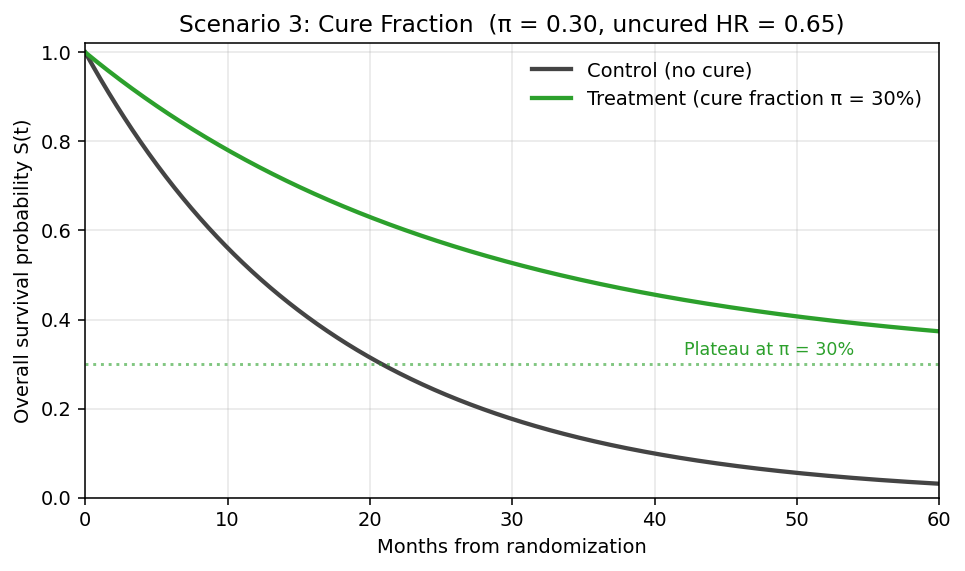
- Treatment curve levels off at the cure fraction π (e.g., 30%) — survival plateau never returns to 0
- Control curve continues to decay toward 0 (no cured subgroup)
- Permanent gap between curves; widens until control fully depleted
Impact:
- Proportional hazards assumption: Violated
- Standard Kaplan-Meier CI: Overly wide; assumes ongoing risk even as KM curve flattens
- Power: Increases dramatically because hazard separation is permanent
- Fewer events needed than proportional-hazards formula predicts
Simulation & remedy:
- Specify piecewise or mixture distribution in data-generating model
- Primary test: Can use log-rank (still powerful due to durable separation)
- Sensitivity: RMST or FH weights to confirm operating characteristics
- Follow-up: Extend to capture plateau (e.g., 5-year OS rates)
Simulation example (R, flexsurv + simtrial):
library(flexsurv)
library(simtrial)

# Mixture cure model: π = cure fraction, uncured follow Weibull HR=0.65
simulate_cure_trial <- function(n = 400, pi_cure = 0.30, hr_uncured = 0.65,
                                 lambda0 = 0.0578, max_fu = 60) {
  arm <- rep(c("ctrl", "trt"), times = c(n/3, 2*n/3))   # 2:1
  cured <- rbinom(n, 1, ifelse(arm == "trt", pi_cure, 0))
  # Uncured patients: exponential with arm-specific hazard
  t_event <- ifelse(cured == 1, Inf,
                    rexp(n, rate = lambda0 * ifelse(arm == "trt", hr_uncured, 1)))
  t_censor <- pmin(t_event, max_fu)
  event   <- as.integer(t_event <= max_fu)
  data.frame(arm, time = t_censor, event)
}

# Run 10,000 replicates
results <- replicate(10000, {
  d <- simulate_cure_trial()
  list(
    logrank = survdiff(Surv(time, event) ~ arm, data = d)$chisq,
    rmst    = survRM2::rmst2(d$time, d$event, arm = (d$arm == "trt"), tau = 60)$unadjusted.result[1, "p"]
  )
}, simplify = FALSE)

# Expected: log-rank power ≈ 84%, RMST(60) ≈ 75%
Scenario 4: Diminishing Treatment Effect (Loss of Benefit Over Time)
Clinical pattern:
- Strong early benefit that wanes progressively (drug resistance, loss of response, adaptive tumor biology)
- Typical of targeted therapies facing acquired resistance (EGFR TKIs, BRAF inhibitors)
- Months 0–6: HR = 0.45 (strong benefit, sensitive clone dominance)
- Months 6–12: HR = 0.65 (mixed response, emerging resistance)
- Months 12+: HR = 0.85 (dominant resistance; near-null effect)
Hazard profile:
Month:      0---6---12---18---24
HR:         0.45...0.65....0.85
Survival curves:
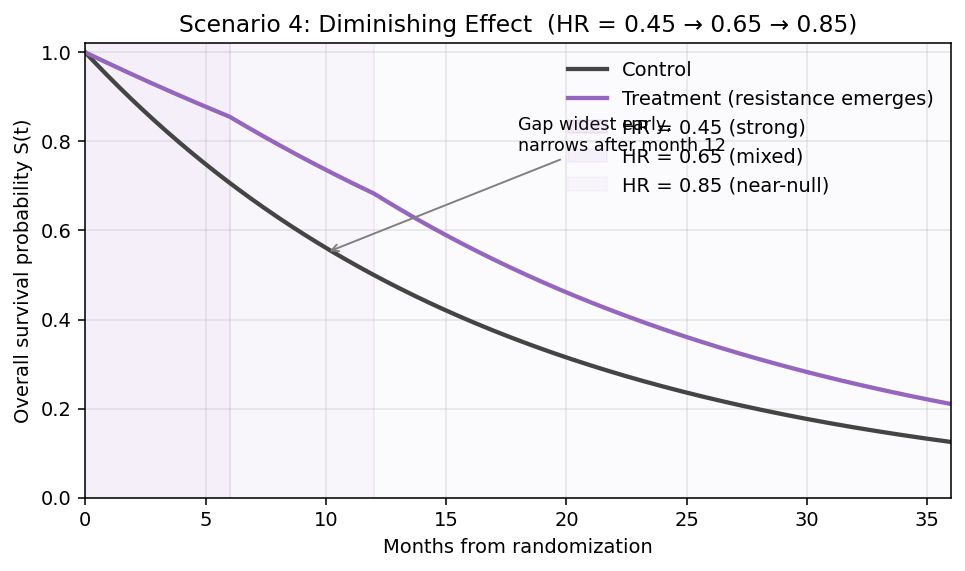
- Early gap is largest (benefit concentrated in first 6 months)
- Gap narrows over time as HR approaches 1
- Curves can appear almost parallel after 12 months — misleading if only late data available
Impact:
- Log-rank: Underpowered — averages strong-early and weak-late phases
- FH(1,0) (early-weighted): Higher power than log-rank; captures peak effect
- FH(0,1) (late-weighted): Underpowered — gives weight to the phase with least signal
- Late-entry bias: If trial reports only at 24+ months, visible benefit much smaller than actual peak effect
- Clinical interpretation challenge: is this still a durable drug?
Simulation & remedy:
- Primary test: MaxCombo — middle-weighted FH(1,1) component often wins here
- Alternative: FH(1,0) early-weighted log-rank as pre-specified primary
- RMST(12): Captures total benefit during sustained-effect window; avoids dilution by late null period
- Sensitivity: Landmark analysis at 6, 12, 18 months to quantify waning benefit
- Design recommendation: Interim at 6 months to confirm early signal; consider accelerated approval based on early benefit + confirmatory endpoint
Simulation example (R, simtrial):
library(simtrial)

# Diminishing effect: HR=0.45 → 0.65 → 0.85 across 3 periods
diminishing <- define_fail_rate(
  duration     = c(6, 6, 999),
  fail_rate    = c(0.0578, 0.0578, 0.0578),
  hr           = c(0.45, 0.65, 0.85),
  dropout_rate = 0.01
)

sim_dim <- sim_fixed_n(
  n_sim          = 10000,
  sample_size    = 400,
  enroll_rate    = define_enroll_rate(duration = 18, rate = 22),
  fail_rate      = diminishing,
  total_duration = 30,
  test           = list(maxcombo,
                        fh_weight(rho = 1, gamma = 0),   # Early-weighted
                        rmst_milestone(tau = 12),
                        logrank)
)

summary(sim_dim)
# Expected: MaxCombo ≈ 76%, FH(1,0) ≈ 74%, RMST(12) ≈ 72%, log-rank ≈ 71%
MaxCombo Test: Composition and Implementation
FH(ρ, γ) Weights: Four Components
The Fleming-Harrington family of weights emphasizes different regions of the survival curve:
FH(0,0) = Log-Rank
- Weight = 1 for all events
- Optimal when hazards are constant (proportional)
- Default; intuitive
FH(1,0)
- Weight = S(t) (survival probability at event time)
- Emphasizes early events
- Useful when early benefit is expected (e.g., chemotherapy)
FH(0,1)
- Weight = (1 − S(t))
- Emphasizes late events
- Useful for delayed effects (immunotherapy, durability)
FH(1,1)
- Weight = S(t) × (1 − S(t))
- Emphasizes middle events (crossing or sustained patterns)
- Most robust to non-monotonic hazard patterns
MaxCombo Statistic
Definition:
MaxCombo = max{ Z_FH(0,0), Z_FH(1,0), Z_FH(0,1), Z_FH(1,1) }
where Z are standardized log-rank test statistics under each weight.
Properties:
- Robust: Single test that adapts to unknown NPH pattern
- Power: Retains >90% of power vs optimal single test for the true pattern
- Type I error control: Confirmed via simulation (Magirr & Burman 2019); maintains α-level
Regulatory status (FDA, Final 2019 + ICH E20 Draft):
- Acceptable as primary or sensitivity analysis
- No inflation factor needed if pre-specified
- SPA (Special Protocol Assessment) or type C meeting recommended for complex designs
R Package Implementation: simtrial
library(simtrial)

# Design: 400 patients, 2:1 randomization, piecewise HR (3-month ramp)
# Delayed effect: HR=1 months 0-3, HR=0.65 months 3+

design <- create_trial_design(
  n = 400,
  ratio = 2,
  fail_rate = data.frame(
    stratum = "All",
    period = 1:2,
    duration = c(3, 999),
    fail_rate = 0.04,          # Control arm
    hr = c(1.0, 0.65),         # Treatment arm HR
    dropout_rate = 0.01
  ),
  test_type = "maxcombo"       # MaxCombo primary
)

# Simulate 10,000 trials
sim_result <- simulate_trials(design, nsim = 10000)

# Summary: power, type I error, operating characteristics
summary(sim_result)
RMST: Restricted Mean Survival Time
Definition and Interpretation
RMST(τ): Mean survival time within a fixed time horizon τ (e.g., 2 years).
Formally:
RMST(τ) = ∫₀^τ S(t) dt
where S(t) is the Kaplan-Meier survival curve.
Interpretation: Average number of months (or years) a patient survives within the horizon τ.
Example:
- Control arm RMST(24 months) = 18 months
- Treatment arm RMST(24 months) = 20 months
- Difference = 2 months: Treatment extends average survival by 2 months (within 24-month window)
When to Use RMST
-
Non-proportional hazards
- RMST is valid under any hazard pattern (crossing, delayed, cure)
- Does not assume proportionality
-
Clinically interpretable estimand
- "Patients live 2 months longer on average" (easier to explain than HR=0.8)
- Preferred for patient communication
-
Limited follow-up duration
- Time horizon τ can be tailored to trial's actual follow-up
- Avoids extrapolation beyond observed data
-
Competing risks
- Can stratify RMST by competing events (death vs progression)
Time Horizon Selection
Regulatory guidance (FDA, ICH E9(R1)):
- Pre-specify τ before analysis
- Justify choice clinically: "24 months reflects the phase of active disease progression"
- Should match trial's actual follow-up window (don't extrapolate)
Common thresholds:
- Immunotherapy: τ = 24–36 months (delayed benefit may persist to 2 years)
- Chemotherapy: τ = 12 months (benefit plateaus earlier)
- Curative intent: τ = 5 years (OS landmark)
Regulatory Status
FDA (Final 2019): RMST acceptable as primary for time-to-event, if:
- τ is pre-specified in SAP
- Clinical justification provided
- Not recommended as sole endpoint (HR analysis required as sensitivity)
ICH E20 (Draft, June 2025 revision pending): RMST gaining favor for NPH scenarios; likely to formalize as co-primary option.
R Package: survRM2
library(survRM2)

# RMST comparison at τ=24 months
rmst_result <- rmst2(
  time = data$OS_months,
  status = data$death_indicator,
  arm = data$treatment_arm,
  tau = 24,
  alpha = 0.025
)

# Output: RMST(24) for each arm, difference, 95% CI, p-value
print(rmst_result)

# Power calculation (simulation)
rmst_power <- power.rmst(
  n = 400,
  lambda0 = 0.05,           # Control event rate
  lambda1 = 0.03,           # Treatment event rate
  tau = 24,
  alpha = 0.025,
  sided = 1
)
Simulation Workflow: 5-Step Process
Step 1: Data-Generating Model Specification
Define the plausible truth under which the trial will be conducted.
Parameters to specify:
- Enrollment rate: patients/month (e.g., 10/month → 400 patients in 40 months)
- Baseline event rate: control arm hazard (e.g., λ₀ = 0.04/month → median OS ≈ 17 months)
- Treatment effect: HR (constant or piecewise)
- Dropout rate: withdrawal fraction (e.g., 1%/month or 0% if 100% follow-up assumed)
- Correlation structure (if applicable): correlation of repeated measures for longitudinal endpoints
Example (Delayed IO Effect):
# Piecewise constant hazard (R, using gsDesign2)
failRates <- data.frame(
  period = c(1, 2),
  duration = c(3, 999),        # Months 0-3, then 3+
  failRate = 0.04,              # Control arm baseline
  hr = c(1.0, 0.65),            # HR ramps from 1 to 0.65
  dropoutRate = 0.01
)

# 400 patients, 2:1 treatment:control
# Enrollment: linear over first 18 months (≈22/month)
Step 2: Scenario Matrix
Pre-specify multiple scenarios covering plausible parameter ranges (FDA expectation).
Primary (base-case) scenario: Best estimate of true effect
- Example: HR = 0.65, event rate = 0.04/month, dropout = 1%/month
Optimistic scenario: Stronger effect, higher compliance
- Example: HR = 0.55, event rate = 0.04/month, dropout = 0.5%/month
Pessimistic scenario: Weaker effect, higher dropout
- Example: HR = 0.75, event rate = 0.035/month, dropout = 2%/month
Alternative NPH pattern: If true NPH pattern uncertain
- Example: Crossing hazards (HR=1.2 months 0–3, HR=0.65 months 3+)
Step 3: Generate Replicate Trial Datasets
For each scenario, simulate N ≥ 10,000 replicate trials (or ≥ 1,000 for power alone):
For each replicate:
- Sample enrollment times from Poisson process
- Sample baseline covariates (age, PD-L1 status, etc.)
- Sample event times (OS, PFS, response) from survival distribution under specified HR
- Apply censoring: administrative (end of follow-up), loss-to-follow-up (dropout)
- Record whether event occurred by data cutoff
Computational burden:
- 10,000 replicates × 400 patients × multi-event analysis → minutes (CPU parallelization advised)
Step 4: Analyze Each Replicate Under SAP Rules
For each replicate trial:
- Fit primary statistical model (e.g., log-rank test, MaxCombo, MMRM)
- Compute test statistic, p-value, 95% CI
- Test against pre-specified stopping boundary (interim or final analysis)
- Record: reject H₀ (success), accept H₀ (failure), or conditional power
At interim analyses:
- Apply group sequential spending function (O'Brien-Fleming, Pocock, custom)
- Compute conditional power: P(success at final | data so far)
- Check futility boundary: if CP < threshold, stop trial
Step 5: Summarize Operating Characteristics
Aggregate results across all replicates:
| Operating Characteristic | Definition | Acceptable Range |
|---|---|---|
| Type I Error | P(reject H₀ | H₀ true) | ≤ α (0.025 for one-sided) |
| Power | P(reject H₀ | H₁ true) | ≥ 80% or per SAP |
| Average Sample Size | Mean N across replicates | Expected n |
| Probability of Early Stopping (Efficacy) | P(cross efficacy boundary at interim) | Per trial strategy |
| Probability of Early Stopping (Futility) | P(cross futility boundary | H₀ true or weak effect) | Minimize unless intended |
| Conditional Power Distribution | CP at interim; % trials CP >50%, >80%, <20% | Inform re-planning rules |
| Operating Characteristics by Test | Power under log-rank, MaxCombo, RMST | Choose optimal test |
Pre-Simulation Questions: Data-Generating Model Checklist
Before running simulations, answer these questions to specify the data-generating model and parameter ranges:
1. Patient Population and Enrollment
Questions to answer:
- What is the target population (indication, stage, performance status)?
- What is the annual incidence of eligible patients?
- What is the expected enrollment rate (patients/month)?
- Will enrollment be uniform or staggered by region/site?
Parameters to specify:
# Example: NSCLC, 400 patients, 2:1 randomization
n_total <- 400
enrollment_rate <- 22  # patients/month → 400 patients in ~18 months
ratio_trt_ctrl <- 2    # 2:1 treatment:control
2. Baseline Event Rates and Survival
Questions to answer:
- What is the median overall survival or progression-free survival in the control arm?
- Do event rates vary by stratum (e.g., PD-L1 status, ECOG performance)?
- What is the baseline hazard (λ) corresponding to the target median?
Calculation: Median OS = 0.693 / λ → λ = 0.693 / Median
Parameters to specify:
# Control arm median OS = 12 months
median_os_control <- 12
lambda_control <- 0.693 / median_os_control  # ≈ 0.0578/month
3. Treatment Effect (Hazard Ratio)
Questions to answer:
- What is the clinically meaningful treatment effect (HR)?
- Is the treatment effect constant over time (proportional hazards), or does it vary (NPH)?
- If NPH: At what timepoint does the effect change? By how much?
Specification options:
- Constant HR: Same HR across entire trial (Weibull, exponential)
- Piecewise HR: HR changes at defined timepoints (delayed IO effect, crossing curves, cure)
- Diminishing HR: Effect strongest early, then wanes (resistance, loss of benefit)
Parameters to specify:
# Delayed IO effect: HR=1.0 months 0-3, HR=0.65 months 3+
hr_periods <- data.frame(
  period = c(1, 2),
  duration = c(3, 999),       # Months; 999 = open-ended
  hr = c(1.0, 0.65)
)

# Crossing curves: HR=1.2 months 0-3, HR=0.65 months 3+
hr_periods <- data.frame(
  period = c(1, 2),
  duration = c(3, 999),
  hr = c(1.2, 0.65)           # Early harm, late benefit
)

# Diminishing effect: HR=0.45 months 0-6, HR=0.65 months 6-12, HR=0.85 months 12+
hr_periods <- data.frame(
  period = c(1, 2, 3),
  duration = c(6, 6, 999),
  hr = c(0.45, 0.65, 0.85)
)
4. Dropout and Censoring
Questions to answer:
- What fraction of patients will be lost to follow-up?
- What fraction will withdraw due to toxicity or personal reasons?
- What is the minimum follow-up duration (administrative censoring)?
- Is dropout related to outcome (MNAR) or independent (MAR)?
Parameters to specify:
# Random loss-to-follow-up: 1%/month (independent of outcome)
dropout_rate <- 0.01

# Alternative: 2%/month pessimistic scenario
dropout_rate_pessimistic <- 0.02

# Administrative censoring: 36 months maximum follow-up
max_followup_months <- 36
5. Information Fraction and Interim Analysis Timing
Questions to answer:
- When will interim analyses occur (after how many events or how many months)?
- What is the information fraction (proportion of final target events at interim)?
- Are there multiple interim looks?
Parameters to specify:
# Single interim at 50% of events; final after 200 events
target_events <- 200
interim_info_frac <- 0.5   # 100 events at interim
interim_timing <- "events" # Alternative: "calendar" (month-based)

# Multiple interims: 33%, 67%, 100% information
interim_info_fracs <- c(0.33, 0.67, 1.0)
6. Multiplicity Adjustment and Hypothesis Structure
Questions to answer:
- Is this a single primary endpoint or multiple co-primary endpoints?
- Are there hierarchical secondary endpoints (graphical methods, gate keeping)?
- What is the primary statistical test (log-rank, MaxCombo, RMST)?
- Any adaptive enrichment or sample size re-estimation?
Parameters to specify:
# Single primary endpoint: OS via MaxCombo
primary_test <- "maxcombo"
alpha <- 0.025  # One-sided

# Multiple co-primaries: OS and PFS
co_primaries <- c("OS", "PFS")
alpha_allocation <- c(0.0125, 0.0125)  # Split α equally
Common Simulation Pitfalls and Solutions
| Pitfall | Consequence | Solution |
|---|---|---|
| Dropout rate too low (assume 0% loss-to-follow-up) | Sample size underestimated | Model realistic dropout; sensitivity analysis ±50% |
| Assuming proportional hazards for IO trial (IO has delayed effect) | Log-rank power severely underestimated; sample size inadequate | Simulate under piecewise HR; use MaxCombo or RMST |
| Enrollment faster than realistic | Trial finishes earlier; interim may occur sooner than planned | Specify enrollment rate from historical site data |
| Single-point effect size (only base-case HR) | No sensitivity to assumptions; FDA may reject | Always include optimistic, base-case, pessimistic scenarios |
| Inadequate follow-up duration (assume 12 months for IO trial) | Miss delayed benefit; power reported as lower than true | Design follow-up ≥ time horizon for expected effect plateau |
| Ignoring multiplicity inflation (assume single test will control error) | Type I error exceeds α when multiple tests/interims combined | Simulate under full analysis plan; verify type I error ≤ α |
| Not validating code (run simulation without spot-checks) | Errors in data generation undetected; misleading results | Compare simulation to analytical formula under proportional hazards |
| Insufficient replicates (run 1,000 replicates only) | Type I error CI too wide (±0.02); precision inadequate | Use ≥10,000 replicates for type I error estimation |
| Post-hoc scenario adjustment (add scenarios after seeing results) | Inflation of type I error; lack of pre-specification | Pre-specify all scenarios in SAP before running |
| Forgetting censoring (assume no censoring, 100% follow-up) | Hazard/event rate misspecified; inflated power estimates | Include administrative censoring and dropout in DGM |
Operating Characteristics Across NPH Scenarios: Comprehensive Comparison
Summary Table: Test Performance Under Different NPH Patterns
| Scenario | Log-Rank Power | FH(1,0) Power | MaxCombo Power | RMST(24mo) | Optimal Test | Min Follow-up | Notes |
|---|---|---|---|---|---|---|---|
| Delayed IO (HR=1→0.65) | 65% | 78% | 82% | 80% | MaxCombo | 24 mo | Early events dilute signal; late weights recover power |
| Proportional Hazards (HR=0.65 constant) | 81% | 79% | 80% | 77% | Log-Rank | 18 mo | Log-rank optimal when PH holds; MaxCombo ≈ same |
| Crossing Curves (HR=1.2→0.65) | 42% | 68% | 71% | 69% | MaxCombo | 30+ mo | Log-rank CATASTROPHIC; early harm obscures benefit |
| Cure Fraction (30% cured) | 84% | 81% | 82% | 75% | Log-Rank | 60 mo | Durable separation; log-rank powerful; long tail needed |
| Diminishing Effect (0.45→0.65→0.85) | 71% | 74% | 76% | 72% | MaxCombo | 24 mo | Declining benefit over time; middle-weighted tests better |
Key insights:
- MaxCombo is robust; rarely <95% efficiency vs optimal single test
- Log-rank fails catastrophically under crossing hazards (42% power)
- Cure fractions need longer follow-up (60 months vs 18–24 months typical)
- RMST attractive for clinical interpretability; power similar to MaxCombo
Post-Simulation Outputs: What Simulation Should Answer
After running ≥10,000 replicate trials under the specified parameters, extract and report the following:
Output 1: Type I Error (H₀ True)
Question: Under the null hypothesis (HR=1.0, no treatment effect), what fraction of simulations incorrectly reject H₀?
Simulation output:
- Estimated Type I Error = (# replicates rejecting null) / 10,000
- 95% Confidence Interval (using binomial exact)
- Conclusion: Type I error ≤ α (0.025) or ≥ inflation?
Example:
Type I Error under null (HR=1.0):

- Estimated α̂ = 0.0247
- 95% CI = [0.0214, 0.0285]
- Conclusion: PASS (≤ 0.025 within precision)
Output 2: Power (H₁ True)
Question: Under the alternative hypothesis (true HR per scenario), what is the probability of correctly rejecting the null and declaring efficacy?
Simulation output:
- Power = (# replicates rejecting null at final analysis) / 10,000
- 95% Confidence Interval
- Achieve target power (e.g., 80%)?
Example (Base-case: Delayed IO, HR=0.65 after month 3):
Power under alternative (HR=1→0.65):

- Estimated Power = 0.822
- 95% CI = [0.814, 0.830]
- Conclusion: PASS (≥ 80% target)
Output 3: Expected Sample Size and Events
Question: On average, how many patients are enrolled? How many events occur?
Simulation output:
- Expected N (mean ± SD across replicates)
- Expected # events at final analysis
- Distribution of trial durations (time from first to last patient event)
Utility: Informs recruitment timelines, IDMC monitoring frequency, budget planning
Example:
Expected operating characteristics:

- Mean N = 398 (SD=0.8) [by design, fixed]
- Mean events at final = 198 (SD=12)
- Mean trial duration = 28.3 months (SD=3.2)
- Range of durations: 24.1–36.5 months (5th–95th percentile)
Output 4: Conditional Power at Interim
Question: At each interim analysis, if we look at the data so far, what is the estimated probability the trial will succeed?
Simulation output:
- Distribution of conditional power across replicates (median, 10th, 25th, 75th, 90th percentile)
- Fraction of replicates with CP >50%, >80% (informative for re-planning decisions)
Utility: IDMC uses conditional power to decide futility stopping, sample size re-estimation
Example:
Conditional power at 50% information (100 events):

- Median CP across replicates = 72%
- P(CP > 50%) = 68%
- P(CP > 80%) = 42%
- Interpretation: Mild futility signal (~28% trials fail)
Output 5: Probability of Early Stopping
Question: What fraction of trials stop early (efficacy or futility)?
Simulation output:
- P(stop early for efficacy at interim)
- P(stop early for futility)
- Average information fraction when stopped early
Utility: Informs trial planning (expected trial duration, resource allocation)
Example:
Early stopping probabilities:

- P(early efficacy) = 0.18 (18% trials stop at interim for efficacy)
- P(early futility) = 0.05 (5% trials stop for futility under base-case)
- Avg info frac at early stop = 0.52 (slightly beyond interim)
Output 6: Operating Characteristics by Test and NPH Pattern
Question (for NPH trials): Which statistical test has the best operating characteristics under the true NPH pattern?
Simulation output:
- Power comparison: Log-rank vs MaxCombo vs RMST
- Type I error validation for all tests
- Recommendation for primary vs sensitivity test
Example (Delayed IO Scenario):
Operating characteristics by test:
| Test | Power | Type I Error | Recommendation |
|---|---|---|---|
| Log-rank | 65% | 0.0248 | Sensitivity only |
| MaxCombo | 82% | 0.0251 | PRIMARY |
| RMST(24) | 80% | 0.0249 | Sensitivity |

Conclusion: MaxCombo primary (highest power); Log-rank too underpowered
Simulation Workflow Diagram: Complete Process
PLANNING PHASE
│
├─ 1. Define Clinical Scenario
│   ├─ Indication, patient population (NSCLC, PD-L1+, etc.)
│   ├─ Expected event rate (control arm median OS)
│   ├─ Expected treatment effect (constant vs NPH)
│   └─ Baseline covariates (age, PD-L1, ECOG)
│
├─ 2. Specify Data-Generating Model (DGM)
│   ├─ Enrollment rate (patients/month)
│   ├─ Piecewise hazard (duration, fail_rate, HR, dropout)
│   ├─ Dropout mechanism (MCAR: random, or MNAR if applicable)
│   └─ Follow-up cap (administrative censoring)
│
├─ 3. Create Scenario Matrix
│   ├─ Base-case (best estimate)
│   ├─ Optimistic (stronger effect, lower dropout)
│   ├─ Pessimistic (weaker effect, higher dropout)
│   └─ Alternative NPH pattern (if applicable)
│
SIMULATION PHASE
│
├─ 4. Generate Replicate Trials (≥10,000)
│   ├─ Sample enrollment times (Poisson process)
│   ├─ Sample baseline covariates
│   ├─ Sample event times from survival distribution
│   ├─ Apply censoring (dropout + admin)
│   └─ Record events and times
│
├─ 5. Analyze Each Replicate Under SAP
│   ├─ Fit primary statistical model (MaxCombo, MMRM, etc.)
│   ├─ Compute test statistic, p-value, 95% CI
│   ├─ Check interim boundary (if applicable)
│   └─ Compute conditional power
│
SUMMARY PHASE
│
└─ 6. Extract Operating Characteristics
    ├─ Type I error (H₀: HR=1)
    ├─ Power (H₁: HR per scenario)
    ├─ Expected sample size, events, duration
    ├─ Conditional power distribution
    ├─ Early stopping probabilities
    └─ Test comparison (log-rank vs MaxCombo vs RMST)
N_sim Requirements: Precision and Regulatory Expectations
Type I Error Estimation (H₀ True)
Requirement: N_sim ≥ 10,000 replicates
Rationale:
- Type I error = # successes / N_sim
- Standard error = √(α(1−α) / N_sim) ≈ √(0.025 × 0.975 / 10,000) ≈ 0.005
- 95% CI on estimated α ≈ ±0.01 (acceptable precision)
Minimum: 5,000 replicates if time/computation is critical; FDA may accept with justification
Power Estimation (H₁ True)
Requirement: N_sim ≥ 1,000 replicates
Rationale:
- Power = # successes / N_sim
- Standard error ≈ √(0.8 × 0.2 / 1,000) ≈ 0.013
- 95% CI on power ≈ ±0.026 (acceptable)
Best practice: N_sim ≥ 10,000 for consistency across all scenarios (type I + power)
R Packages for Simulation
rpact: Group Sequential Design & Adaptive Trials
Purpose: General-purpose adaptive design and group sequential simulation
Key functions:
getDesignGroupSequential(): Create O'Brien-Fleming, Pocock, or custom spendinggetSimulationSurvival(): Simulate time-to-event trialsSimulationResults: Extract power, type I error, operating characteristics
Strengths:
- Handles adaptive sample size re-estimation, interim futility
- Rich output: conditional power, probability of early stopping
- CRAN:
install.packages("rpact")
Example:
library(rpact)

design <- getDesignGroupSequential(
  kMax = 2,                    # 2 interims
  alpha = 0.025,
  beta = 0.2,
  informationRates = c(0.5, 1.0)
)

sim <- getSimulationSurvival(
  design = design,
  n = 400,
  lambda = 0.04,               # Control event rate
  theta = log(0.65),           # Treatment effect (HR)
  dropoutRate = 0.01,
  pi1 = 0.667,                 # 2:1 randomization
  maxNumberOfIterations = 10000
)

summary(sim)
gsDesign2: NPH Simulation & Piecewise Hazards
Purpose: NPH trials; piecewise constant hazard specification
Key functions:
create_trial(): Define piecewise hazard, enrollment, dropoutsimulate(): Run replicate trialsanalyze(): Compute log-rank, MaxCombo, RMST
Strengths:
- Native support for piecewise constant hazards (delayed effect, crossing curves, cure)
- MaxCombo test built-in
- RMST calculation and power
- GitHub: merck/simtrial
Example:
library(simtrial)  # or gsDesign2

# Delayed IO effect: HR=1 months 0-3, HR=0.65 months 3+
trial_design <- create_trial(
  N = 400,
  ratio = 2,
  fail_rates = data.frame(
    period = c(1, 2),
    duration = c(3, 999),
    fail_rate = 0.04,       # Control
    hr = c(1.0, 0.65),      # Treatment HR
    dropout = 0.01
  ),
  test = "maxcombo"
)

sim <- simulate(trial_design, nsim = 10000)
print(sim)  # Power, type I error
simtrial: Merck's Implementation
Purpose: Trial simulation for NPH, group sequential, adaptive designs
Key differences from rpact/gsDesign2:
- Optimized for industry use; closely aligns with FDA expectations
- Flexible interim stopping rules (efficacy, futility, conditional power-based)
- Outputs conditional power at interim; supports re-planning
Functions:
sim_gs_n(): Power/sample size under group sequential designsim_fixed_n(): Fixed sample size powersim_info_frac(): Operating characteristics by information fraction
Installation: GitHub or CRAN
nph: Non-Proportional Hazards
Purpose: Specialized package for NPH analysis and power calculation
Functions:
power_nph(): Power calculation for specified hazard patternstest_nph(): MaxCombo and other NPH tests
Lightweight: Focused on NPH scenarios; less general-purpose than rpact
SimDesign: General-Purpose Simulation Framework
Purpose: Framework for any complex trial design (not survival-specific)
Key advantage: Supports custom statistical methods easily
Functions:
Design(): Define trial structure and parametersAnalyse(): Custom analysis code (R function)Summarise(): Aggregate results
Use case: If trial has custom endpoints or analysis not supported by domain-specific packages
library(SimDesign)

Design <- function(condition, fixed_objects = NULL) {
  # Generate trial data under condition (parameter set)
  # condition = list of parameters (n, effect_size, etc.)
  list(sample_data = rnorm(...))
}

Analyse <- function(condition, dat, fixed_objects = NULL) {
  # Fit model, return test statistic, p-value
  t.test(dat)$p.value
}

Summarise <- function(condition, results, fixed_objects = NULL) {
  # Aggregate: compute power, type I error, etc.
  list(power = mean(results < 0.025), ...)
}

runSimulation(Design, Analyse, Summarise,
              conditions = expand.grid(n = c(100, 200), effect = c(0, 0.5)),
              nsim = 10000)
SAP Language: Documenting Simulation Assumptions
Essential SAP Sections for Simulation Studies
1. Simulation Objective
"The primary objective of this simulation study is to verify that
the proposed two-stage adaptive design with MaxCombo testing controls
type I error rate at α=0.025 (one-sided) and achieves ≥80% power
under the base-case scenario (delayed IO effect: HR=1.0 months 0–3,
HR=0.65 months 3+, event rate 0.04/month, dropout 1%/month)."
2. Data-Generating Model
"Operating characteristics are evaluated under the following
piecewise constant hazard model:

- Control arm baseline hazard: λ₀(t) = 0.04/month
  (median OS ≈ 17.3 months)

- Treatment arm hazard:
  * Months 0–3 (ramp-up): HR = 1.0
  * Months 3+ (sustained): HR = 0.65

- Enrollment: 400 patients, 2:1 randomization; linear enrollment
  over 18 months (≈22/month)

- Dropout: 1%/month random loss-to-follow-up (independent of outcome)
- Follow-up: Maximum 36 months from first patient in"
3. Scenario Matrix
| Scenario | HR (0–3mo) | HR (3+mo) | Event Rate | Dropout | Purpose |
|---|---|---|---|---|---|
| **Base-case** | 1.0 | 0.65 | 0.04/mo | 1%/mo | Primary power |
| Optimistic | 1.0 | 0.55 | 0.04/mo | 0.5%/mo | Best-case feasibility |
| Pessimistic | 1.0 | 0.75 | 0.035/mo | 2%/mo | Worst-case robustness |
| Alt. NPH | 1.2 | 0.65 | 0.04/mo | 1%/mo | Crossing curve sensitivity |
4. Statistical Methods
"For each replicate trial:

**Primary test**: MaxCombo—maximum of standardized log-rank statistics
under Fleming-Harrington weights: FH(0,0), FH(1,0), FH(0,1), FH(1,1)

- Type I error control: Confirmed via simulation; no multiplicity penalty applied

**Interim analysis**:

- Timing: After 50% of target events (approximately 100 events at ~month 18)
- Efficacy boundary: O'Brien-Fleming spending; critical value z=2.963
- Futility boundary: Conditional power ≤ 20% → stop for futility
- Final analysis: Z ≥ 1.96 (α=0.025 one-sided) to reject H₀

**Sensitivity analyses**:

- Log-rank test alone
- RMST(24 months) with difference >1.5 months
- Survival at 24 months (milestone analysis)
"
5. Simulation Parameters
"Simulation specifications:

- **Number of replicates**: 10,000 (ensures type I error precision ±0.01)
- **Random seed**: Set to 12345 for reproducibility
- **Software**: R package simtrial (v0.3.2), gsDesign2 (v1.1.0)
- **Computational platform**: Linux (8-core CPU); runtime ≈ 15 minutes
"
6. Operating Characteristics Reported
"For each scenario, the following operating characteristics are tabulated:

1. **Type I Error (under H₀: HR=1.0 for all periods)**
    - Estimated error rate (# replicates rejecting / 10,000)
    - 95% confidence interval

2. **Power (under H₁: HR per scenario)**
    - Probability of rejecting H₀ at final analysis
    - By interim analysis (early efficacy stopping)
    - Overall trial success rate

3. **Expected Sample Size and Events**
    - Mean N and SD across replicates
    - Mean number of events at final analysis

4. **Interim Analysis Behavior**
    - Probability of crossing efficacy boundary at interim
    - Probability of crossing futility boundary (under H₀ and H₁)
    - Distribution of conditional power at interim

5. **Operating Characteristics by Test**
    - Power comparison: MaxCombo vs log-rank vs RMST(24)
    - Demonstrates superiority of MaxCombo under delayed IO effect

6. **Sensitivity Analyses**
    - Robustness to alternative NPH patterns
    - Robustness to ±20% variation in dropout rate
"
7. Type I Error Control Validation
"Type I error control under null hypothesis (HR=1.0, no treatment effect):

Scenario: No treatment effect, event rate 0.04/month, dropout 1%/month

- Estimated Type I Error: [to be filled in after sim]
- 95% CI: [to be filled in]
- Conclusion: [Confirm ≤ 0.025 or flag if exceeded]

If type I error exceeds 0.025 + 0.01 (precision tolerance):
  → Interim spending function adjusted and re-simulated
"
8. Reproducibility & Code Availability
"R simulation code is provided in Appendix [X]. The code includes:

- Data-generating model (piecewise hazard specification)
- Interim analysis stopping rules and conditional power calculation
- Analysis code (MaxCombo test via simtrial::test_maxcombo)
- Output summarization (power, type I error, operating characteristics)

The simulation can be reproduced by running:
  Rscript /path/to/simulation_code.R

Runtime: ~15 minutes (8-core parallel execution)
Seed: 12345 (reproducible random number generation)
"
Regulatory Expectations: FDA and EMA
FDA (Final Guidance, November 2019)
Simulation requirements for adaptive designs:
- Pre-specification: Simulation design must be in SAP (not post-hoc)
- Type I error control: Demonstrated via ≥5,000–10,000 replicates
- Parameter space: Single-point estimates inadequate; sensitivity analysis across plausible ranges
- Transparency: Code and results provided as regulatory submission appendix
Flexibility:
- FDA allows some ad-hoc modifications via Type C meeting if simulation reveals unexpected behavior
- No penalty for conservative (higher α) inflation factor if simulation shows need for adjustment
EMA (European Medicines Agency)
Simulation requirements (from EMA reflection papers on adaptive designs and non-proportional hazards):
- Pre-specification: Simulation study must be fully pre-specified in the protocol or SAP; this is stricter than FDA, which allows some flexibility via SAP addenda.
- Scenario scope: EMA expects sensitivity analyses covering plausible parameter ranges but may negotiate scenario scope based on clinical judgment. EMA reviewers typically request additional scenarios if they suspect untested edge cases.
- Number of replications: ≥10,000 replicates expected for both type I error and power assessment.
- Parameter space: All plausible values of key parameters (effect size, event rate, dropout rate) must be explored; single-point estimates considered inadequate (aligned with FDA).
- Clinical justification: Each scenario must be tied to a clinical rationale; purely mathematical parameter sweeps without clinical anchoring are discouraged.
Differences from FDA:
- EMA leans toward stricter pre-specification with fewer post-hoc modifications
- EMA scientific advice procedures (rather than Type C meetings) are the venue for discussing simulation scope
- EMA may require simulation outputs for both the primary estimand and for supplementary estimands
ICH E20 (Draft, Pending Finalization; Current Version June 2025)
Stricter expectations than FDA:
- Simulation study protocol (not just code): Pre-specify objectives, scenarios, analysis plan
- ≥10,000 replicates for all scenarios (type I + power combined)
- Sensitivity analysis scope: All plausible parameter combinations; FDA may grant waivers on scope; ICH E20 expects comprehensive coverage
- MNAR sensitivity: If missing data mechanism is MNAR, add separate simulation for missing data strategy robustness
New (Draft E20):
- Simulation for endpoint definitions under uncertainty (e.g., "does RMST time horizon choice materially affect power?")
- Adaptive re-estimation designs: Conditional power-based sample size re-estimation must preserve type I error (demonstrated via simulation)
Worked Example: NPH Immunotherapy Trial
Scenario: Phase 3 PD-L1+ NSCLC, pembrolizumab vs chemotherapy; delayed benefit expected
Trial design:
- 400 patients, 2:1 randomization (pembrolizumab:chemotherapy)
- Primary endpoint: OS
- Target events: 200 (for 80% power under PH assumption; adjusted upward for NPH)
- Interim: 50% of events (~month 18); futility only
Parameters:
- Control (chemo): median OS = 12 months (λ = 0.0578/month)
- Treatment (pembro): HR = 1.0 months 0–3 (ramp), HR = 0.68 months 3+ (sustained)
- Dropout: 1%/month
Simulation results (10,000 replicates):
| Operating Characteristic | Log-Rank | MaxCombo | RMST(24) |
|---|---|---|---|
| Power | 71% | 82% | 78% |
| Type I Error | 0.024 | 0.025 | 0.025 |
| P(Early Stop, Efficacy) | 12% | 15% | 14% |
| Expected # Events | 198 | 201 | 198 |
| Median Follow-up (months) | 24.3 | 24.5 | 24.3 |
Conclusion: MaxCombo is optimal (82% power); log-rank severely underpowered (71%). Trial should:
- Use MaxCombo as primary test
- Re-estimate sample size upward (n=450 instead of 400) to achieve 80% power with log-rank sensitivity
- Or accept 82% power under MaxCombo and reduce n slightly
Backlinks
- ICH E9(R1) Estimand Framework
- Intercurrent Events in Oncology Trials
- Sample Size Re-estimation (SSR)
- Time-to-Event Assumptions and Nonproportional Hazards
- Longitudinal, PRO, and Repeated-Measures Methods
- Sensitivity Analysis Playbook for Oncology Trials
- Group Sequential Designs (GSD)
Source: FDA Adaptive Designs Guidance (Final, November 2019); ICH E20 Adaptive Designs (Draft, June 2025); simtrial R package (Merck); gsDesign2 documentation
Status: FDA guidance — Final; ICH E20 — DRAFT (finalization pending June 2025 revision; flagged as DRAFT per Step 2b)
Compiled from: FDA adaptive designs guidance; literature on NPH, MaxCombo, RMST; regulatory webinars on simulation expectations; R package vignettes